

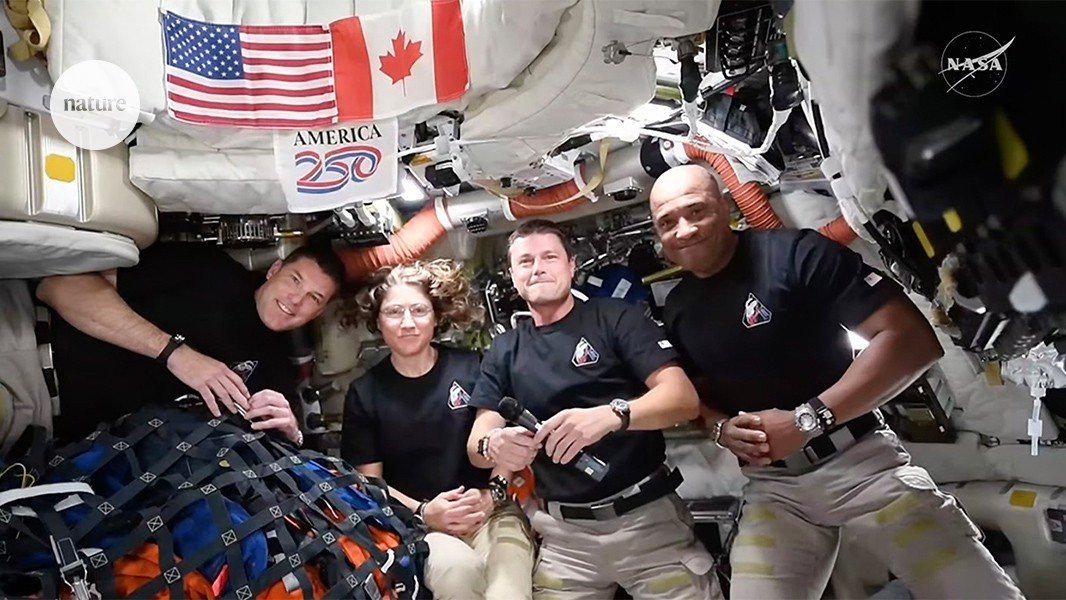

The four Artemis II astronauts inside of the Orion capsule before they spoke to US President Donald Trump, after the Moon fly-by.Credit: NASA
Updated 6 April 2026, 10.05 p.m. CDT (Houston time)
The astronauts spoke over a phone link with US President Donald Trump on their way back from the Moon. Continuing a tradition that stems back to President Richard Nixon calling Neil Armstrong and Buzz Aldrin on the lunar surface in 1969, Trump congratulated the Artemis II crew for their successful mission so far. “You really are modern-day pioneers, all of you,” he told the astronauts.
Trump asked how the far side of the Moon looked, and how it felt to be out of touch with the rest of humanity. Wiseman talked about the low lighting on the lunar far side, and how they saw the Sun, Moon and planets lined up during the eclipse they witnessed. Glover said they were busy working while they were out of communication, “and I must say it was actually quite nice”.
“You have a lot of courage doing what you’re doing,” Trump told the crew. “A lot of bravery.”
This wraps our coverage of the Artemis II Moon flyby. Stay tuned to nature.com/news, and Nature’s social media channels, for ongoing coverage of the mission.
Updated 6 April 2026, 8.34 p.m. CDT (Houston time)
The lunar fly-by is nearly over. So what’s next for the Artemis II mission?
Tomorrow morning the astronauts will meet (virtually!) with the mission’s science team to talk about some of the observations they made of the Moon’s far side. Then they will spend the next three days flying back to Earth.
On Friday 10 April they will return to our planet in spectacular fashion. The Orion capsule will separate from the service module that has provided it with power and propulsion during its journey. As it enters Earth’s atmosphere it will begin to heat up and slow down. (There is some debate about how well the heat shield will protect the capsule as it travels through scorching temperatures, although NASA seems confident it will survive just fine.) The capsule will unfurl a series of parachutes to slow it down even more, and ultimately Orion will splash down in the Pacific Ocean off the coast of California.
A team of Navy divers, working with NASA, will retrieve the astronauts from the capsule and bring them back on shore — their welcome back to terra firma. — Alexandra Witze

Credit: Jasiek Krzysztofiak/Nature
Updated 6 April 2026, 8.12 p.m. CDT (Houston time)
Impact! The astronauts have observed at least four ‘impact flashes’ caused by micrometeorites hitting the lunar surface. Mission scientists had hoped the crew would catch a glimpse of these flashes of light but did not know how easy they would be to see. Apollo astronauts saw at least three of them on the night side of the Moon during their flights in the 1960s and 1970s.
“Incredible news, Reid,” science officer Kelsey Young told astronaut Reid Wiseman. Amateur astronomers and citizen scientists have been monitoring the Moon as well during the Artemis II flight, to see if they can also detect flashes on the dark part of the Moon.
The solar eclipse is underway, and Wiseman says he did not anticipate just how much sunlight would still illuminate the Moon from behind. “The entire Moon is lit up, it’s glowing behind the entire Moon,” he said. — Alexandra Witze
Updated 6 April 2026, 7:45 p.m. CDT (Houston time)
Reader question: How long will it take to build a base on the Moon?
NASA has talked about building a Moon base for decades, with plans waxing and waning over the years as political priorities shifted. But with a human mission flying past the Moon today, there’s no question that the US is closer to that goal than it’s been in decades.
The question is whether NASA can follow through on plans to come after Artemis II. Most immediately, the astronauts have to return safely to Earth on 10 April. After that, NASA administrator Jared Isaacman has said he wants the next Artemis flight to take place next year, to test components in Earth orbit that would be used to carry humans to the lunar surface on future flights.
After that, Isaacman envisions ramping up launches and delivering loads of cargo to the lunar surface to help construct the base. He wants to see a base finished by 2036, at a cost of US$30 billion. NASA has proposed slashing its science programmes in order to help pay for human spaceflight priorities such as the Moon base. — Alexandra Witze

Artemis II Commander Reid Wiseman peered out of one of the Orion spacecraft’s main cabin windows, looking back at Earth, on 4 April.Credit: NASA
Updated 6 April 2026, 7:15 p.m. CDT (Houston time)
The Artemis astronauts are about to experience a solar eclipse.
This isn’t a total solar eclipse that you might think of here on Earth, where the Moon blocks the Sun’s light almost perfectly such that the Sun’s wispy outer atmosphere — its corona — becomes a visible wraith around a dark void. From Orion’s viewpoint, the small Sun will simply pass behind the much-larger Moon for just under an hour.
As the Sun slides behind the Moon’s disk and out again, the astronauts will glimpse part of its corona. They will observe and map how it looks, from a different three-dimensional vantage point than researchers can get with ground-based or space-based telescopes.
Because the solar corona changes shape and appearance every day, in particular when the Sun is more active, researchers are interested in all the data they can get on how it appears from different angles at different points in time. — Alexandra Witze
Updated 6 April 2026, 6.42 p.m. CDT (Houston time)
Orion has emerged from the far side of the Moon, and the astronauts are back in touch with mission control.
“It is so great to hear from Earth again,” said astronaut Christina Koch, as communications were re-established. “Ultimately, we will always choose Earth, we will always choose each other.”
After 40 minutes of being out of contact, the astronauts photographed Earth ‘rising’ from behind the dark lunar disk. The bright Earth slid out from behind the dark Moon; the astronauts are looking along the Moon’s edge to see if they can spot any Moon dust illuminated from behind. This is a rare chance to hunt for lunar dust that is normally too faint to see.
The Earthrise doesn’t look like the famous ‘Earthrise’ image from the Apollo 8 mission in 1968. Back then, the Apollo astronauts weren’t anticipating the Earth to appear, and were caught somewhat off guard and scrambled to photograph the blue-and-white globe emerging from below the gray lunar horizon. The image became an icon of the US environmental movement of the 1970s.
Artemis II astronauts are seeing an Earth rise that is a slim crescent, just a fraction of our planet writ whole. — Alexandra Witze

View of the Moon (and a sliver of Earth) from the Orion capsule just before the crew went into a communications blackout.Credit: NASA
Updated 6 April 2026, 6.01 p.m. CDT (Houston time)
The Orion capsule has just made its closest pass by the Moon, at a distance of 4,067 miles (6,545 kilometres) from the surface. In a few minutes, it will set yet another record: reaching a maximum distance from Earth, now estimated at 252,756 miles (406,771 kilometres). — Alexandra Witze
Updated 6 April 2026, 5.43 p.m. CDT (Houston time)
Communications with the astronauts are are dropping out for a while. As Orion passes behind the Moon, it and mission controllers back on Earth will lose contact for around 40 minutes. This is because the Moon is literally in the way. And unlike China, which has sent two telecommunications satellites to orbit the Moon, the United States does not have any lunar infrastructure in place to relay signals from the far side.
Expect a few nail-biting moments until the astronauts re-emerge. “Every time we see [the drop in comms], it is just like a movie,” says Barbara Cohen, a planetary scientist who is on the Artemis II lunar science team. “Hey, are you back yet? Hey, are you back yet?”
“We will see you on the other side,” astronaut Victor Glover told NASA. — Alexandra Witze

Artemis II mission specialist Christina Koch on the fourth day of the mission.Credit: NASA
Updated 6 April 2026, 5.33 p.m. CDT (Houston time)
The astronauts have also been remarking quite a bit on the Moon’s ‘terminator’. This is the boundary between its illuminated side and its dark side that constantly moves as the Moon rotates on its axis. Astronomers like to observe the Moon along its terminator because the changing light conditions can reveal additional details about mountains, craters, valleys and other geological phenomena.
Artemis II astronaut and pilot Victor Glover in particular sounds captivated by the Moon’s terminator today. “What it does to the features of the Moon, to the terrain…there’s just so much magic in the terminator,” he said. “The islands of light, the valleys that look like black holes [where] you’d fall straight to the centre of the Moon if you stepped in some of those. It’s just so visually captivating — the terminator is the most striking thing I’ve seen so far.”
To him, one crater along the terminator looked like a dinosaur footprint. — Alexandra Witze
Updated 6 April 2026, 5.07 p.m. CDT (Houston time)
“Full Moon Joy” is becoming somewhat of a catchphrase of this mission, the NASA commentator just noted on the livestream for the Moon fly-by. That stems from an exchange between Artemis II commander Reid Wiseman and mission control in Houston a few days ago. Wiseman spooled off a list of the various Moon features he was seeing up close for the first time: “Just seeing Tycho, there’s mountains to the north. You can see Copernicus, Reiner Gamma. It’s just everything in three dimensions and absolutely unbelievable. This is incredible.”
“Copy, Moon joy,” mission control radioed back.
Scientists on the Artemis II mission team are talking about having T-shirts made with the phrase “Copy, moon joy” on them. — Alexandra Witze

Nature correspondent Alexandra Witze has been interacting with the Artemis II mission scientists throughout the day. Here’s a shot she took from inside the science evaluation room.Credit: Alexandra Witze/Nature
Updated 6 April 2026, 5.01 p.m. CDT (Houston time)
The astronauts have been asking the science team some nerdy questions about what they’re seeing. One of the main things the crew are looking at is the Orientale basin, a 3.8-billion-year-old impact basin with three enormous concentric rings. Astronaut Reid Wiseman reported seeing brownish tones in the outer part of Orientale, although his colleague Victor Glover didn’t quite see the same colouration. Brown is becoming something of a theme for today. The Moon, to human eyes that are closer to it, might appear more brown and less grey than we Earth-bound observers see.
To try to keep their eyes attuned to subtle colour differences on the lunar surface, the astronauts have put a T-shirt across one of the capsule’s windows to help block light. They’re calling it a shroud. It did, however, cause more condensation than they would have liked, so the astronauts have been using a condensation hose to try to dry things up. — Alexandra Witze
Updated 6 April 2026, 4.33 p.m. CDT (Houston time)
Nature correspondent Alexandra Witze is with the mission scientists today at Johnson Space Center in Houston. She asked them how they’re feeling and what they’re most excited for the astronauts to observe on the Moon. Check out this video, put together from Alex’s interviews. We’re gonna be crying a lot over here too, scientists.
Updated 6 April 2026, 4.19 p.m. CDT (Houston time)
Reader question: The astronauts are seeing parts of the Moon that the human eye hasn’t seen before. Why?
We’ve put together a graphic to answer this one. Apollo astronauts travelled closer to the lunar surface than the Artemis II astronauts are. This means that the Apollo crews saw only small swathes of the lunar surface. They also saw the far side in darkness because their mission trajectory was designed to land astronauts on the near side during daylight.
So the Artemis II astronauts are indeed seeing parts of the far side, illuminated, for the first time in human history. Approximately 21% of the far side’s disk (including the Orientale impact basin) is in sunlight during today’s fly-by. The rest of the Moon that they are seeing illuminated today is its much more familiar near side.

Image credit: NASA
Updated 6 April 2026, 4.03 p.m. CDT (Houston time)
The astronauts have been switching spots at the capsule windows. Reid Wiseman and Jeremy Hansen were the first to do observations and take photos. Then it was Christina Koch and Victor Glover’s turn. Now, they’re about to switch back.
The astronauts have three cameras on board: two Nikon D5 DSLRs, which are the workhorses of spaceflight photography, and one Nikon Z9, a newer mirrorless camera that was added at nearly the last moment. These automatically take three exposures for every press of the button. The first is an exposure that the Artemis II team members think is correct for the lighting conditions in that moment, the second is one that they think will be underexposed and the third is one that they think will be overexposed — to be sure one of the images will turn out well.
They are using a 400-millimetre lens to get as much detail as possible of the lunar disk. The astronauts observe the Moon in pairs, one photographing the surface while the other observes with the naked eye. They have trained to recognize basic geological features of the Moon, including the massive Orientale impact basin that is a major focus of today’s studies because it has never been observed fully by the human eye before. — Alexandra Witze
Updated 6 April 2026, 3.18 p.m. CDT (Houston time)
Reader question: Do the astronauts have science in their backgrounds?
Some of them do, yes. Mission specialist Christina Koch is an engineer who worked at scientific field stations in Greenland and Antarctica. Mission specialist Jeremy Hansen has a master’s degree in physics and worked at the underwater Aquarius laboratory off the coast of Florida, which is meant to emulate deep-space flight. (Incidentally, although this is Hansen’s first flight to space, Koch holds a number of spaceflight records.)
Reid Wiseman, the commander, set a record for science in orbit when he and a colleague performed 82 hours of research on the International Space Station during a single week in 2014.
The fourth astronaut, pilot Victor Glover, is a Navy aviator and test pilot. — Alexandra Witze

The Artemis II crew during a training session at Johnson Space Center in Houston.Credit: NASA/James Blair
Updated 6 April 2026, 2.51 p.m. CDT (Houston time)
The Artemis II lunar science team is getting what they were hoping for. On board the Orion capsule, the astronauts have observed craters at the north and south poles. Colour differences continue to be a theme: “The more I look at the Moon, the browner and browner it looks,” one of the astronauts said.
Astronaut and pilot Victor Glover is describing some challenges in looking from his dim laptop to the bright Moon and back down again, all while juggling logistics to capture the grandeur of the moment. — Alexandra Witze
Updated 6 April 2026, 2.34 p.m. CDT (Houston time)
I’ve been fortunate enough to gain access to the ‘science evaluation room’, a brand-new workspace in the main mission control building at Johnson Space Center in Houston. This is the kind of thing that sounds really bureaucratic, but in the extremely hierarchical world of NASA human spaceflight, it’s a big deal for science to have its own space. There’s a cluster of science specialists working together here to feed information and research to a top ‘science officer’ — planetary scientist Kelsey Young — who has a seat in the primary mission control room. (They don’t let reporters in that room generally.)
The mood here is quiet, tense and full of anticipation. There was no celebratory moment to mark the start of the lunar fly-by — just a bunch of scientists focusing on their display screens with visualizations of the lunar surface and the capsule trajectory.
Christina Koch, one of the astronauts, told mission control that they were comparing the brightnesses of Earth and the Moon. Young noted that as the astronauts’ eyes adjust, more features might become visible. The crew has turned down lights in the capsule to help their eyes adapt to darkness.
The astronauts have reported seeing green and brown colours in the Aristarchus region of the Moon’s near side. That’s a part of the Moon that astronomers can see from Earth, but the report of colour variations caused an excited murmur in the room. The scientists are keen to have any colour reports like this from up close at the lunar surface. — Alexandra Witze

Science officer Kelsey Young monitors Artemis II operations from a console inside NASA’s mission control in Houston.Credit: NASA/Bill Stafford
Updated 6 April 2026, 2.16 p.m. CDT (Houston time)
This morning, reporters — including yours truly — visited mission control at the Johnson Space Center in Houston. This is the nerve centre of the Artemis II mission. And it’s the room where the flight director and the capcom (the astronaut designated to communicate with the Orion capsule) sit, as well as the room that holds all those consoles you’ve seen in film documentaries. Huge display screens showed the countdown to various mission milestones, including splashdown on 10 April.
We were there when mission control broadcast a message from legendary Apollo astronaut Jim Lovell to the Artemis II crew, as they woke this morning, the day of their lunar fly-by. “Welcome to my old neighbourhood,” said Lovell, who piloted the 1968 Apollo 8 mission that was the first to fly humans around the Moon, just as Artemis II is doing today. “Don’t forget to enjoy the view,” he said. “Good luck, godspeed, from all of us here on the good Earth.” Lovell recorded the message before he died on 7 August last year. — Alexandra Witze

NASA staff members were posing for a photo this morning as Nature correspondent Alexandra Witze visited mission control.Credit: Alexandra Witze/Nature
Updated 6 April 2026, 2.07 p.m. CDT (Houston time)
As the Artemis II crew set their distance record from Earth, they made a request: to name some “relatively fresh craters on the Moon that have not been previously named”. In particular, they suggested names for two craters that they observed from Orion’s windows this morning and that were originally pointed out to them by the science team. They suggested naming the first, north of the massive Orientale basin on the Moon’s far side, Integrity, after their spacecraft. The second, on the Moon’s near side–far side border, they asked to name Carroll, after commander Reid Wiseman’s wife, who passed away in 2020. During certain times of transit, Carroll would be visible on Earth.
Updated 6 April 2026, 1.51 p.m. CDT (Houston time)
The lunar fly-by has begun. I’m in the science evaluation room for the Artemis II mission, where flowers just got delivered for science officer Kelsey Young, from her mother. NASA science head Nicola Fox is also in the house.
Team leader Marie Henderson just told the assembled scientists that they needed to focus on getting their work done while also appreciating the historic nature of the moment. “There’s going to be a lot of excitement today,” she said.
Then she went around asking the group leaders in the room to give her a ‘go’ for fly-by. One by one, they all polled ‘go’.
“We are go for lunar flyby,” Henderson said.— Alexandra Witze
Updated 6 April 2026, 1.05 p.m. CDT (Houston time)
Artemis astronauts set record for distance travelled from Earth by humans
The Artemis II crew has just set a record for the farthest humans have ever travelled from Earth. They have surpassed the record of Apollo 13, set in 1970, of 248,655 statute miles (400,171 kilometres) from our home planet. (Apollo 13 set that record after it suffered an explosion on the way to the Moon, which forced the crew to abort their planned landing and instead slingshot around the far side of the Moon.)
Some scientists and NASA folks will tell you that the distance record doesn’t really matter. It is, after all, something of an artifice — there is nothing fundamentally different about the environment that the Artemis II astronauts will be passing through, thousands of kilometres above the Moon’s surface, to the one that Apollo astronauts did, tens to hundreds of kilometres above the surface. But it is a moment to mark in human history, in which people travel farther from planet Earth than ever before.