

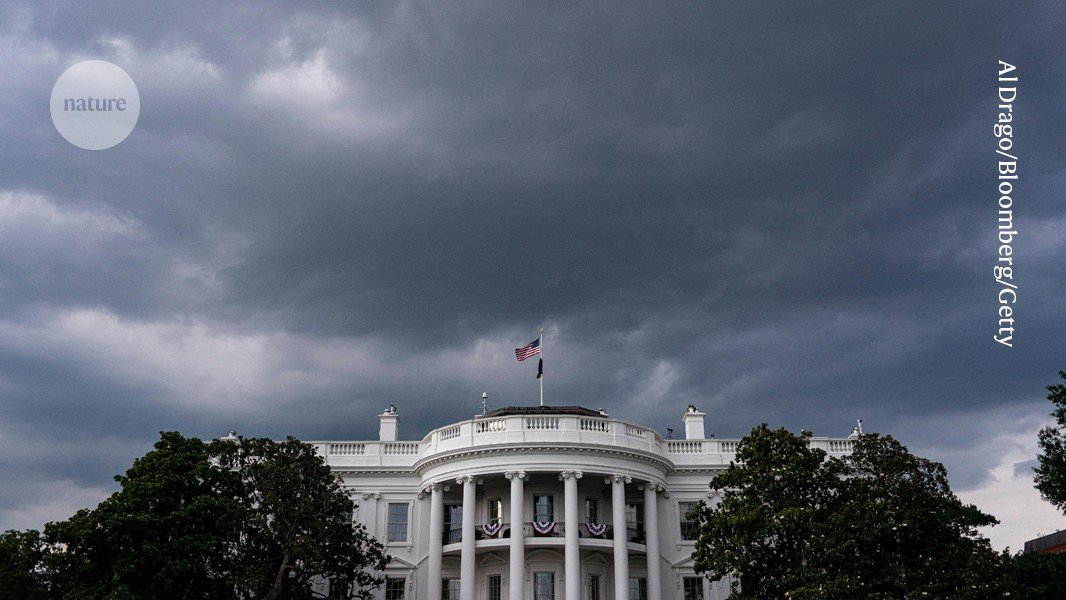

The 2027 budget proposed by the administration of President Trump would make deep cuts to many science agencies, such as the National Science Foundation.Credit: Al Drago/Bloomberg/Getty
For the second year in a row, US President Donald Trump has proposed significant cuts to the budgets of major US science agencies. Released Friday, the White House’s plan for federal spending next year also includes a ban on using federal funds for subscriptions and publishing fees for some academic journals.
The plan proposes cuts to federal agencies that fund or conduct research on health, space and the environment. Some of the steepest cuts would be made to the National Science Foundation (NSF) and the Environmental Protection Agency (EPA): the budgets of both would fall more than 50% in 2027 compared to their current levels (see ‘Budget crunch’). The budget for the US National Institutes of Health would drop 13%.
A budget document says that the proposal would maintain funding for research on quantum information and artificial intelligence “to ensure the United States remains on the cutting edge” in those arenas. The administration plans to increase applied research funding on those topics at the defence and energy departments, says Alessandra Zimmermann, who tracks science budgets and policy at the American Association for the Advancement of Science (AAAS), a non-profit organization in Washington DC. But basic quantum and AI research funding at NSF, for example, would be cut by 37% and 32%, respectively.
‘Congress has your back’: US senators tell scientists they want to protect NIH budget
Ultimately, it is the US Congress that decides how the federal budget will be spent — not the president. Congress rejected the administration’s requests for huge cuts in 2026, restoring funding for many of the programmes the White House sought to eliminate. Trump’s proposal is a starting point for congressional negotiations, which could last until the start of the 2027 fiscal year on 1 October — or even beyond it, because of Congressional elections on 3 November, Zimmermann says.
The budget would increase funding for presidential priorities – such as the military, which would receive US $1.5 trillion, a 44% increase – while reining in spending on many domestic programmes.
Sweeping changes
The White House seeks to slash the NSF budget by nearly 55%, to $4 billion. The proposal also cuts all funding for the NSF division that funds research on the social sciences and economics. At an internal all-hands meeting on Friday, NSF leaders announced that they would dissolve the agency’s Social, Behavioral and Economic Sciences directorate based on the budget request, according to two NSF staff members who shared information anonymously in order to speak freely. The NSF’s budget request to Congress states that the agency will shut down the SBE but maintain SBE “grants that align with Administration priorities, such as in behavioral and cognitive science, and all impacted employees will be transferred to other parts of the agency.”
The proposed cuts to the NSF would be “devastating,” says Leigh Stearns, a glaciologist at the University of Pennsylvania in Philadelphia. “We cannot cut the pipeline and expect the output to continue. This is how the US loses its scientific leadership — with a reckless budget line.”
The proposal would eliminate funding for the National Oceanic and Atmospheric Administration’s Office of Oceanic and Atmospheric Research. It would also shutter three of the NIH’s 27 institutes and centres – those focusing on minority health and disparities, international research and alternative medicine.
NASA faces a 23% cut to its total budget and a 47% drop in funding for its science division. More than 40 projects would be terminated. “It’s an extinction-level event for science,” says Casey Dreier, chief of space policy at the Planetary Society, a non-profit organization in Pasadena, California, that advocates for space exploration. “It would undermine and prevent NASA from being the world leader in space exploration.” NASA declined to comment on Dreier’s statement.
Publishing fees
The proposal would also prohibit the spending of “Federal funds for expensive subscriptions to academic journals and prohibitively high publishing costs unless required by Federal statute or approved in advance by a Federal agency”. The proposal does not define “expensive” or “prohibitively high” or specify which journals would be affected. Many journals “charge the Government to both publish and to access the same research study,” the proposal says, adding that there are many “low cost outlets” for publishing federally funded research.