

(RNS) — A federal judge has ordered the U.S. Department of Homeland Security to allow faith leaders inside a federal holding facility near Minneapolis after the clergy were denied access earlier this year while trying to provide religious support to immigrant detainees.
U.S. District Judge Jerry Blackwell issued a preliminary injunction in support of clergy who sued the federal government, requiring the government to grant faith leaders immediate access to the Bishop Henry Whipple Federal Building — which houses local Immigration and Customs Enforcement offices — while the case proceeds. The judge also instructed the government and the plaintiffs to attempt to work out shared protocol over the next week or so to address specific questions, such as whether faith leaders will be allowed to physically touch detainees.
Irina Vaynerman, cofounder of Groundwork Legal, one of the law firms representing the plaintiffs, told Religion News Service it was unusual for a judge to rule from the bench in such a case.
“It speaks to the merits of the claims here, and also the urgency,” she said, referring to what she called the “continuous irreparable harm that faith leaders and detainees are experiencing every day from not being able to provide or receive pastoral care.”
The lawsuit was filed in February by the Minneapolis Area Synod of the Evangelical Lutheran Church in America, the Minnesota Conference of the United Church of Christ and the Rev. Christopher Collins, a Jesuit priest. The complaint argued that barring faith leaders from delivering pastoral care in Whipple — particularly during Operation Metro Surge, a concentrated immigration enforcement campaign in the Twin Cities area — amounted to a violation of their rights under the First Amendment as well as the Religious Freedom Restoration Act.

FILE – In this Oct. 25, 2019 photo, the Bishop Henry Whipple Federal Building is shown in St. Paul, Minnesota. (AP Photo/Jim Mone)
The Rev. Kelly Gallagher, associate minister of the UCC Minnesota Conference, celebrated the ruling.
“We’re overjoyed as people of faith that the court recognizes the right of people to pastoral care, especially in crisis moments such as being detained,” she said in an interview with RNS on Friday.
Gallagher stressed that for Christians like herself, as well as leaders from other faith traditions, access to detainees and prisoners is one of several “unequivocal matters of faith,” arguing the concern is ancient. “Jesus himself says, ‘I was in prison and you visited me,’” she said.
An RNS reporter was present in January when the Rev. Susie Hayward and two other UCC pastors were denied access to detainees in Whipple. The complaint notes that several faith leaders also sought access to the building on Ash Wednesday, a Christian holy day, and were denied.
Hayward, who was present for the ruling on Friday, said Blackwell used the Ash Wednesday example as evidence of harming immigrants. In addition, Courthouse News reported that the judge compared the situation to “The Wizard of Oz,” saying the government cannot “act like the wizard in a small window.”
“I’m grateful for Judge Blackwell’s ruling today recognizing the irreparable harm caused by the government by violating the religious freedom rights of faith leaders and detainees,” Hayward told RNS in a text message. “And, I think with anguish about all my neighbors who were held in awful conditions at the Whipple Building during the first phase of Operation Metro Surge who were denied spiritual care.”

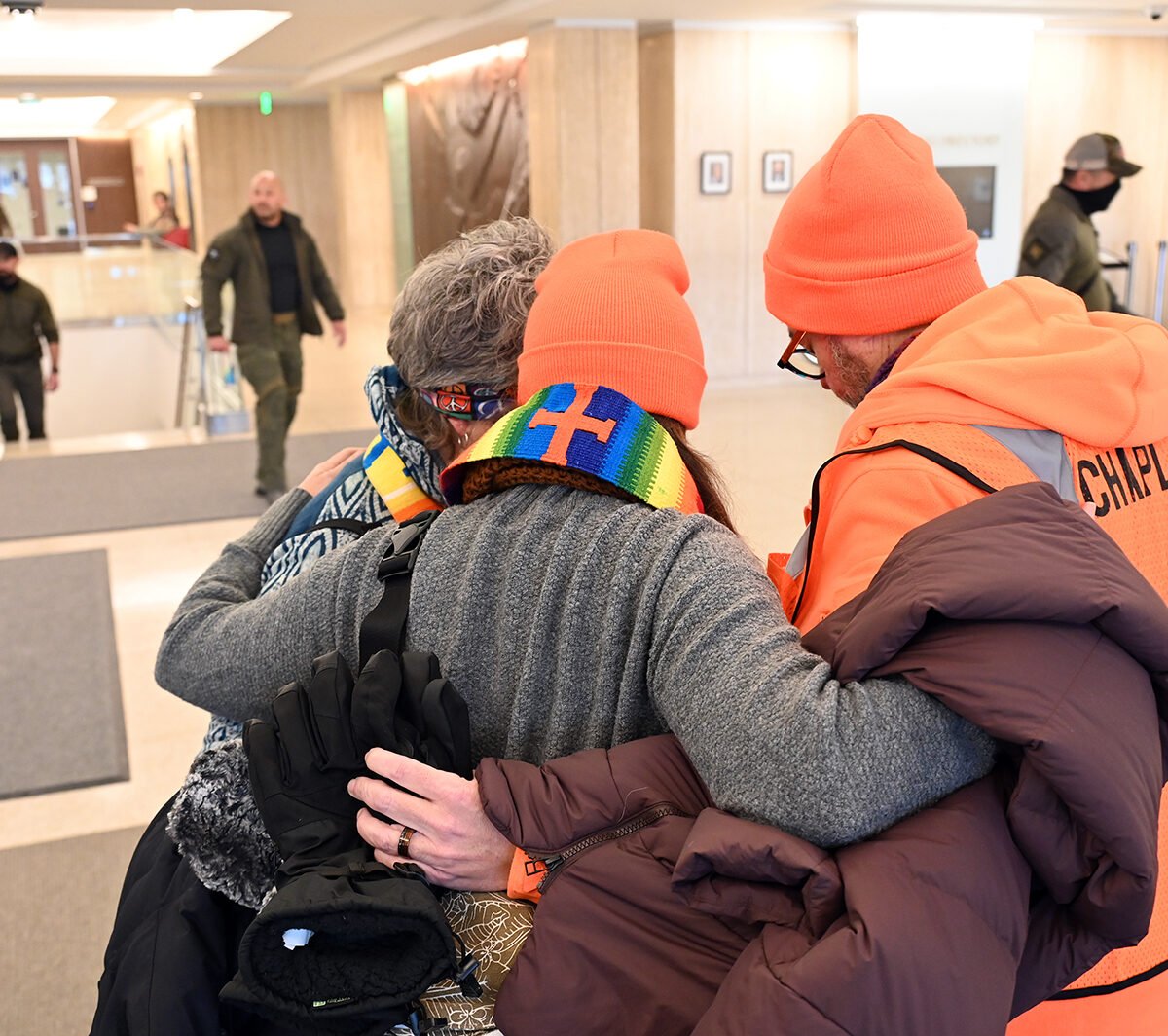
The Revs. T. Michael Rock, from left, Susie Hayward and Rebecca Voelkel pray in the lobby of the Bishop Henry Whipple Building while attempting to minister to detainees, Tuesday, Jan. 13, 2026, in Minneapolis. (RNS photo/Jack Jenkins)
Hayward added: “This is one important step in our struggle for justice and my call to live out Jesus’s command to care for the captives. And we won’t relent.”
Barring faith leaders on Ash Wednesday also contrasted sharply with a related court battle in Broadview, Illinois. There, a group of Catholic leaders filed a similar lawsuit in November pushing for access to a local ICE facility, and a judge allowed two priests and a nun to enter the building on Ash Wednesday.
“This decision reaffirms the humanity of those who are detained and facing fear, isolation, and crisis: our lives have worth, our souls have value,” said Bishop Jen Nagel of the Minneapolis Area Synod of the ELCA, in a statement.
DHS did not immediately respond to a request for comment on the ruling.
Hayward said the end of the timeline to hash out issues, such as whether faith leaders will be able to touch detainees, roughly coincides with Holy Week, the Christian celebration that concludes with Easter. She said clergy are already discussing tentative plans to conduct traditional Holy Week services and rituals at the facility, such as foot-washing for detainees, provided the government allows for it.
White House border czar Tom Homan announced the end of Operation Metro Surge in Minneapolis last month, following widespread protests in the region and international coverage of the killings of Renee Good and Alex Pretti by DHS agents. However, as many as 650 agents remained in Minnesota as of March 4, according to outgoing DHS Secretary Kristi Noem. The actual number of agents remains unclear; U.S. Democratic Sen. Amy Klobuchar recently said a White House official cited a smaller figure, but Hayward told RNS she and others still see ample evidence of DHS in the area.
“Abductions and detentions are still ongoing,” Hayward said.