

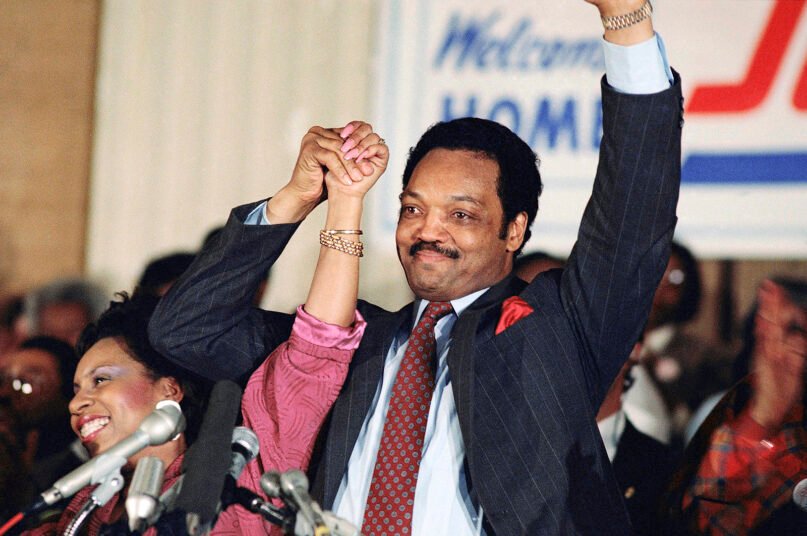
(RNS) — For me, the moment that defined the late Rev. Jesse Jackson was the celebratory rally after Barack Obama won the presidency. I was watching it on television with my father, of blessed memory. When the camera focused on Jackson, you could see tears on his cheeks.
My father said, “He’s probably thinking, ‘It should have been me.’”
“Or, perhaps those are tears of joy,” I said. “America finally has a Black president.”
“Perhaps both,” my father said.
That memory comes back to me as I think of Jackson, who died Tuesday (Feb. 17) at age 84. I remember his massive contributions to the Civil Rights Movement, and to the United States itself; his way with words; and his irrepressible energy.
I also remember the many contradictions that defined him. Which brings me to his connection to one of my favorite rock stars, the former Velvet Underground front man, Lou Reed, who died in 2013 at the age of 71.
Reed was Jewish. He said that while he had no God apart from rock ’n’ roll, his Jewish roots were important to him. He and his wife, Laurie Anderson, used to host a wild and creative Passover Seder in New York City. He visited Israel frequently, last performing in Tel Aviv in 2008, and he had family in Haifa and other Israeli towns. Reed even had an Israeli spider named after him to thank him for his support for the country.

Lou Reed performs at the Hop Farm Music Festival on July 2, 2011, in Paddock Wood, England. (Photo courtesy of Wikimedia/Creative Commons)
In his song “Good Evening Mr. Waldheim,” he excoriated the late Pope John Paul II for welcoming Austrian President Kurt Waldheim to the Vatican in 1987. Waldheim had been a member of the Nazis’ Wehrmacht and was reported to have had direct knowledge of atrocities against Jews. The song then goes:
And here comes Jesse Jackson, he talks of common ground
Does that common ground include me or is it just a sound?
A sound that shakes, oh Jesse, you must watch the sounds you make
A sound that quakes, there are fears that still reverberate
Jesse you say common ground, does that include the PLO?
What about people right here, right now who fought for you not so long ago?
The words that flow so freely falling dancing from your lips
I hope that you don’t cheapen them with a racist slip, oh Common Ground
Is Common Ground a word or just a sound?
Common ground, remember those civil rights workers buried in the ground
If I ran for president and once was a member of the Klan
Wouldn’t you call me on it the way I call you on Farrakhan?
Reed was singing about several significant moments in Jackson’s relationship with the Jews.
In February 1979, Jackson met with Palestine Liberation Organization chairman Yasser Arafat in Beirut. The visit violated official United States policy, which forbade contact with the PLO, which the U.S. considered a terrorist group.
Then, in 1984, Jackson infamously referred to New York City as “Hymietown,” a slur referring to Jews. He subsequently apologized for the remark, saying, “In private talks we sometimes let our guard down and become thoughtless.”
In a subsequent interview Jackson again apologized for the incident:
This matter was obviously a campaign mistake and the handling of it reflected the fatigue of the campaign. … If one had used something as derogatory as “kike” — that’s mean spirited. When you look at the number of Hymans or Hymies in the telephone book, it’s clear that’s not an offensive statement with religious or political overtones in our vernacular. It’s non-insulting colloquial language.
In comparison to the horrific Jew-hatred of our time, “Hymietown” seems tame by comparison. But imagine someone interpreting remarks against any other group by claiming “fatigue.” Worse than that is counting Hymans or Hymies in the telephone book and claiming that it was merely a demographic statement and therefore, noninsulting and colloquial.
Finally, in the early 1980s, the leader of the Nation of Islam, Louis Farrakhan, made multiple antisemitic statements, including saying that Judaism was a “gutter religion.” Some perceived that Jackson was slow to condemn him, but Jackson would change his attitude toward Farrakhan. In 1984, Farrakhan said that the creation of Israel was “an outlaw act,” and Jackson called that statement “reprehensible.”
Reed was a rock star, and not a political commentator. And yet, his decades-ago insights into Jackson and antisemitism deserve our attention because they were prescient. In the song, he referred to the way Jackson used the term “common ground” in a desire to bring people together into a project of decency and social justice — a great and noble goal. Had Reed been alive on Oct. 7, 2023, he would have seen how the left abandoned the Jews in their moment of greatest need; some joined the chorus of voices condemning Israel. Many of us asked, where is that common ground? Where is the dream of us all working together for a better world?
And Reed called upon Jackson to “remember those civil rights workers buried in the ground.” He was talking about the murders of James Chaney, Andrew Goodman and Michael Schwerner by Southern racists in the summer of 1964. Chaney was Black; Goodman and Schwerner were Jews. It exemplified how Black Americans and Jews stood together, marched together, and in one bloody incident, died together. Reed was not saying that the Civil Rights Movement owes the Jews, but rather that our common suffering and struggle bind us together.
And one more sweet, significant fact: In 1971, KAM, the oldest synagogue in Illinois, merged with Isaiah Temple (which had already merged with Temple Israel, which, decades before, had merged with Congregation B’nai Sholom). The result: KAM Isaiah Israel. Who bought the old KAM building in Hyde Park? Jackson’s Rainbow PUSH Coalition, a social justice organization. KAM’s late rabbi, my beloved mentor, Rabbi Simeon Maslin, once said to me, with a twinkle in his eye: “Jesse Jackson is sitting in my old office.”
That twinkle said something. There are numerous stories about Jackson’s respect and partnership with the Jewish people. Rabbi Sam Gordon, rabbi emeritus of Congregation Sukkat Shalom in Wilmette, Illinois, told me that the first call that he got after the deadly Tree of Life synagogue shooting was from the Rev. Jackson, already in failing health, asking: “What can I do to help?”
That is what I choose to remember, today — a great man who was heroic and flawed.