

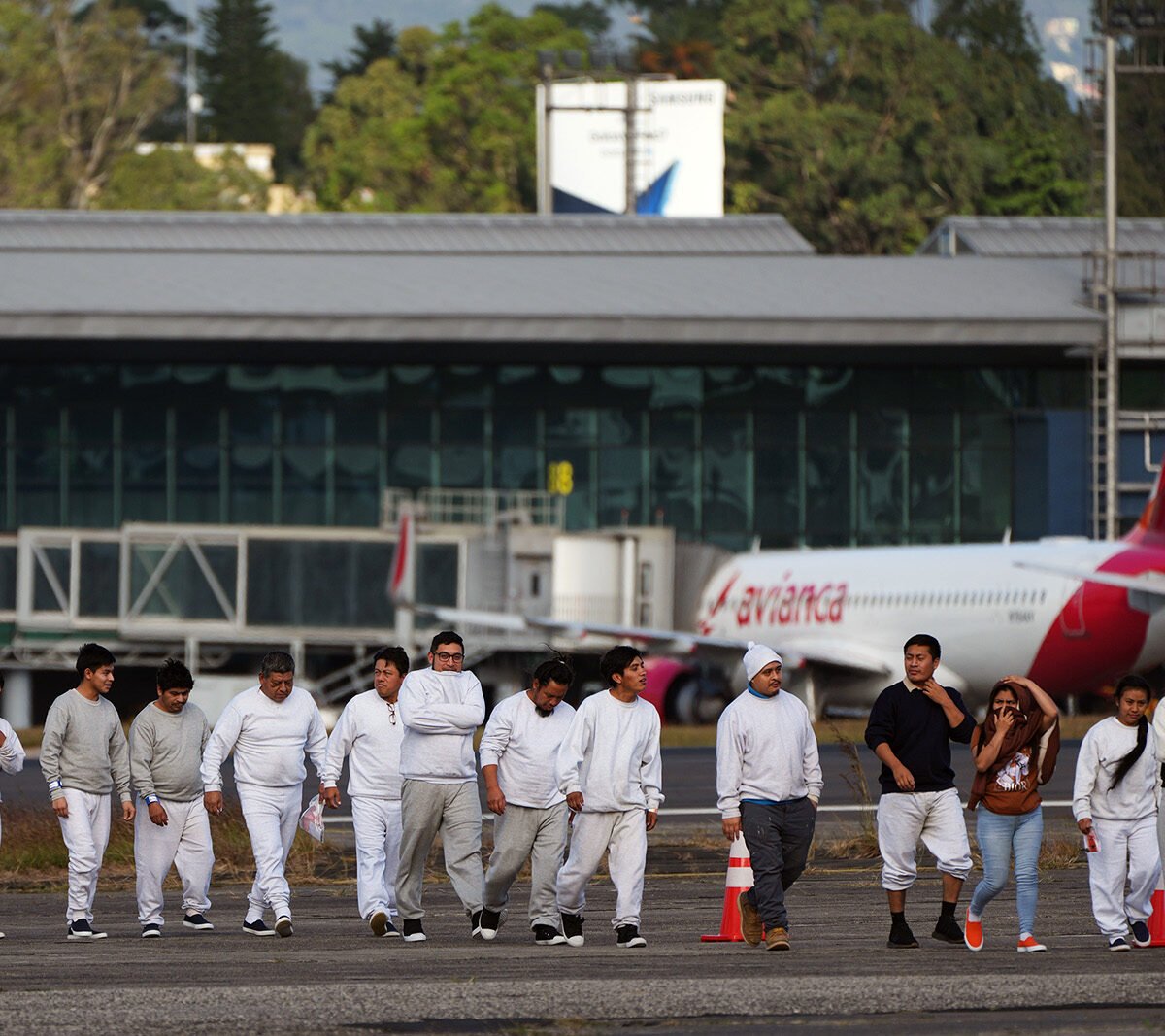
(RNS) — At least once a week, relief workers from Jesuit Refugee Service Mexico see a grim routine: Newly arrived deportees step off planes in Tuxtla Gutiérrez, near Mexico’s southern border, still wearing gray detention uniforms issued in the United States. Transported in handcuffs and stripped of their belongings, they are released onto the street with little more than the clothes they are wearing. Some appear confused. Many do not know where they are.
“People arrive with nothing — no money, no way to move and no network to help them,” said Karen Pérez, country director of Jesuit Refugee Service Mexico, or JRS-MX.
Her staff, which operates from three offices across Mexico, has shrunk from 70 to 28 people in the past year because of U.S. federal funding cuts to humanitarian aid, leaving the group struggling to meet the growing needs of deportees. Similar organizations across Latin America have also faced budget blows. Since January 2025, the Trump administration has dismantled the U.S. Agency for International Development (USAID), prompting a lawsuit from organizations such as Global Health Council and the Jewish refugee aid group HIAS seeking to restore funding. The legal battle continues.
JRS-MX’s budget in 2025 fell by nearly 40 percent, from 33 million Mexican pesos (about $1.7 million) to about 20 million pesos (roughly $1 million), even as deportations surged. More than 140,000 were deported to Mexico, and about 12,000 come from third countries, Mexican officials say. Data compiled by the ICE Flight Monitor project at Human Rights First shows a total of 292 deportation flights to Mexico in 2025 — a 62 percent increase from the 180 flights conducted the prior year during the Biden administration.
“It has been a very hard process,” Pérez said. “It’s like when someone dies and you have to let them go.”
Faith-based refugee aid groups that once relied on U.S. humanitarian funding now face a double crisis across Latin America: more deportations — the Department of Homeland Security reports more than 650,000 globally in 2025 — while the funding they have depended on has collapsed. A federal judge ruled on Feb. 26 that the government’s policy of deporting migrants to “third countries” is unlawful, but the practice continues as the administration is given time to appeal. For faith-based groups like Jesuit Refugee Service, World Relief, HIAS and Fe y Alegría, that has meant reducing staff and scaling back programs even as more deportees arrive, often disoriented, without documentation and in need of basic assistance.
JRS-MX faces additional challenges as migrants increasingly are sent to southern Mexico. Many land in Tapachula, the nearest major city to the Guatemalan border — a region previously rarely used for deportations due to gang violence and limited infrastructure. Some migrants also have criminal records, Pérez said, complicating efforts to provide safe shelter or legal options. “The south of the country is among the poorest regions,” Pérez said. “There isn’t enough capacity even for the local community. It’s much harder with a population that is abandoned in very difficult places.”
At its Tapachula office, JRS-MX staff say they help about 10 to 15 deported people daily with legal and refugee assistance. Most inquire about applying for refugee status in Mexico, and staff help them make calls and talk through what comes next, according to Emma Victorio, who works at the Jesuit Refugee Service office in Tapachula.
RELATED: We practice our faith by welcoming refugees. Now, that work is at risk.
The group also visits detention centers in Ciudad Juárez, in northern Mexico, connecting vulnerable deportees with legal help, psychological support and local shelters. With fewer staff and resources, the group can no longer respond to every request for assistance and must rely more heavily on partner organizations — even as some deportees struggle to rebuild lives they lost in the U.S.
A new report by the American Friends Service Committee documented the challenges facing migrants deported to Mexico. Among 169 deportees interviewed, more than 1 in 5 said they had limited access to food, water or hygiene while in detention. Nearly 29% who arrived in Mexico said they were not informed about the immigration process they were undergoing, while others reported excessive force, discrimination or psychological abuse.
The Department of Homeland Security did not respond to a request for comment.

Jesuit Refugee Service Mexico personnel assist an individual in Mexico. (Photo courtesy of Karen Perez)
World Relief operates in Haiti amid gang violence and political instability that have displaced more than 1.4 million people. The organization has seen estimates suggesting as many as 60,000 to 80,000 Haitians may have been deported from the U.S. over the past year, but the figures are unconfirmed, reflecting the overall opacity of the data from DHS.
“The U.S. Embassy won’t say, and the U.S. government won’t say,” said Charles Franzén, World Relief’s senior regional director, describing U.S. planes that arrive without notice, letting off migrants without passports, documentation, money or much knowledge of the culture. “It’s not just a few. There are many.”
Deep USAID cuts forced World Relief to scale back a multi-pronged Haiti program addressing food security, food assistance, water and sanitation (WASH) and economic recovery (ERMS) issues. Limited State Department funding and private donations recently allowed life-saving food assistance and sanitation services to restart.
World Relief partners with churches near border areas, training them to follow Biblical teachings to “have that heart of supporting” immigrants, said Pascal Bimenyimana, the group’s Haiti field officer. A US federal judge recently temporarily blocked DHS from ending Temporary Protected Status for Haitians, as the legal battle continues, and Franzén warned losing TPS status could trigger even more deportations.
Fe y Alegría, a Jesuit education and job training organization in El Salvador, has faced severe operational challenges after its USAID funding dropped from $6.2 million to zero last year. As a result, its budget in El Salvador fell from $3.5 million in 2025 to $835,000.
The organization reduced staff from 135 employees to 28, relying instead on international donors, tuition from training programs, rental income and local grants, said Alejandro Calderón, country director for Fe y Alegría in EL Salvador.

Goats are distributed to vulnerable women in Haiti’s South Department in a project sponsored by UN Women and World Relief. (Photo courtesy of World Relief)
Fe y Alegría works with about 80 deportees, or “returnees,” each day, roughly 1 in 4 of whom are children, Calderón said. “Imagine a kid who is 10 years old and has lived all his life in the United States or Mexico,” Calderón said. “He doesn’t have the Salvadorian accent, and sometimes even the Spanish is different. Imagine how difficult it is for them to go to school.”
Staff help children reintegrate into the education system, offering stipends to families, mental health support and accompaniment as students adapt to classrooms where their accents and backgrounds may make them stand out. Older youths and adults who did not finish high school can access technical training and vocational programs. “We know that we won’t solve 100% of their issues,” he said. Many still need housing and an ability to communicate with family in the U.S.
For many people working in faith-based refugee aid, faith sustains their work. Pérez acknowledges the uncertainty of the future but said her Catholic faith propels the work regardless.
“Faith is a living, palpable force that we feel on the ground, in the places where no one else is present,” she said, adding that, even though there may be dangerous situations, “we still entrust ourselves to God and to what is truly His work in our lives.”