

(RNS) — Religion in America might be best described in the words of rap artist LL Cool J: Don’t call it a comeback. At least not yet.
Despite claims of a revival of religion in the United States, a new report from Pew Research Center finds young Americans remain less religious than their parents or grandparents, with just over half (55%) claiming a religion.
“On average, young adults remain much less religious than older Americans,” reads the report released Monday (Dec. 8). “Today’s young adults also are less religious than young people were a decade ago.”
However, the decades-long religious decline remains stalled for now, according to the report, which was based on data from two Pew surveys: the National Public Opinion Reference Survey and the 2023-24 U.S. Religious Landscape Study. Since 2020, about 70% of Americans have identified with a religion, according to Pew, a period of relative stability.
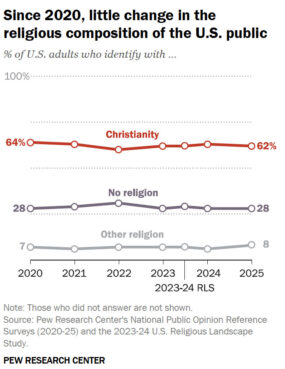
There has been minimal change in religious composition in the U.S. since 2020, according to a PEW research study. Chart courtesy PEW Research Center
The percentage of Americans claiming no faith — a group known as the nones — nearly doubled in size from 2007 (16%) to 2022 (31%). The percentage of Americans who identify with a religion decreased from 84% to 69% during that time period, according to Pew research.
The percentage of nones has settled at around 30% over the past five years.
“The recent stability is striking because it comes after a prolonged period of religious decline,” according to Pew. “For decades, measures of religious belonging, behaving, and believing had been dropping nationwide.”
Pew also found that the number of Americans who pray daily (46%), who say religion is important in their life (43%) and who say they attend services at least once a month (34%) has remained steady over the past few years.
“There is some bouncing around from year to year, as is to be expected in survey research,” Gregory A. Smith, Pew’s senior associate director of research, wrote in the report. “But there is no clear trend of either increasing or decreasing religiousness since 2020.”
Researchers expect the percentage of Americans who are religious will decline in the future, as older Americans die and are replaced by young, less religious Americans.
Just over half (55%) of Americans born between 1995 and 2002 — the youngest group studied in Pew’s latest report — identify with a religion. By contrast, 83% of the oldest Americans studied (born in 1954 or earlier) say they are religious.

Religious behaviors have remained fairly stable since 2020. Chart courtesy Pew Research Center
However, the youngest Americans are slightly more religious than those who are a few years older, Pew found. Among those born between 1995 and 2002, 55% said they identify with a religion in Pew’s National Public Opinion Reference Survey. That jumped to 61% for Americans born between 2003 and 2007, according to the report.
The report also found that 26% of Americans born between 1995 and 2002 say they attend religious services at least monthly, while 41% of Americans born between 2003 and 2007 do so. That’s a significant jump, Smith said in an email.
“This is not the first time we have seen the youngest adults come of age with levels of religiousness that equal or exceed those of slightly older adults. But analysis shows that a gap between these cohorts tends to appear over time,” according to the report.
It’s not clear how long the decline of religion may stay paused. A previous Pew report, based on data from the General Social Survey, showed that during the late 1980s to early 1990s, the percentage of Americans who identified as Christian dropped from 90% to about 80%, then stayed stable for over a decade before dropping again. The percentage of Americans who identified with other religions over the same time period was relatively stable (between 5% and 7%), while the religiously unaffiliated increased in a pattern opposite the Christian decline.
Ryan Burge, a professor of practice at the John C. Danforth Center on Religion and Politics at Washington University in St. Louis, said something similar could be happening now.
“I think it’s the calm before the storm,” said Burge, who writes about the religious landscape in his Graphs about Religion Substack. At some point, the decline will begin again due to generational shifts. “Gravity still goes down,” he said.
Looking at the data, Burge suspects that in the future, just over half of Americans will be religious, with about 45% of Americans identifying as Christians and 10% as other faiths, while just under half will be nones.
Religion in America isn’t going away, he said. But it won’t have the same social power as it did in the past.
Dan Allan, a long-time national staffer for Cru, a national evangelical campus ministry, said he’s seen some signs that religion among younger Americans may be becoming more vibrant. For example, just under 17,000 students attended fall retreats sponsored by Cru campus groups this year, up 7% from last year and nearly 20% from 2023. Allan said attending a retreat is one sign that Cru students are becoming more serious about their involvement.
Allan also said more than 100 groups that minister to American college students have formed a partnership called Every Campus — with the hope of starting new ministries at colleges where there are none.
He said campus groups are seeing both renewed interest in faith and, at the same time, a large segment of students who are not religious. He cited Christian podcaster and writer Carey Nieuwhof, who said that young people are experiencing both “revival and retreat.”
“There’s a great deal of interest and still a set of people who are skeptical,” Allan said.