

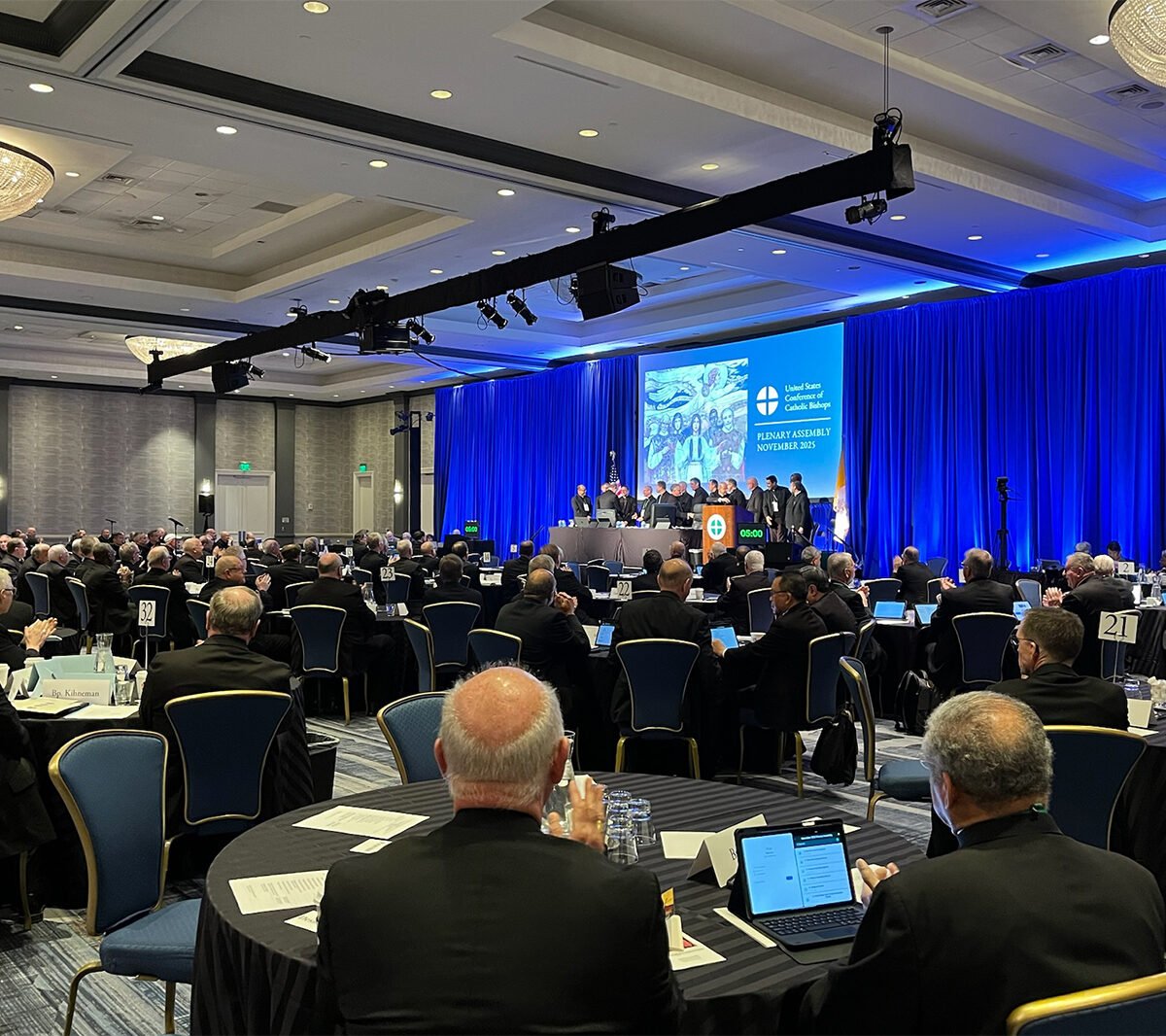
(RNS) — The U.S. Conference of Catholic Bishops has filed an amicus brief in a case before the U.S. Supreme Court opposing President Donald Trump’s efforts to eliminate birthright citizenship, arguing to the majority-Catholic justices that doing away with it would undermine church teaching and the “moral foundations” of the country.
The right of anyone born in the confines of the United States to automatically be a citizen has traditionally been found in the 14th Amendment, ratified in 1868. But the Trump White House claims that birthright citizenship is only an interpretation, not explicitly granted in all instances. In January, the president issued an executive order to end the right, which drew immediate legal challenges and outcry — including from the Catholic bishops.
“The intended and unintended effects of the Executive Order are immoral and contrary to the Catholic Church’s fundamental beliefs and teachings regarding the life and dignity of human persons, the treatment of vulnerable people — particularly migrants and children — and family unity,” the bishops’ brief reads.
The brief is the latest in growing pushback from Catholic leaders about the president’s immigration policies, with the conservative-leaning conference of prelates increasingly at odds with the Republican administration’s efforts to pursue mass deportations. Since Trump’s rash of executive orders issued in the first week of his second term, the sitting presidents of the USCCB as well as those representing its migration committee have sent out statements of deep concern.
In addition to citing the Constitution, history and a slate of past court cases, the bishops quote the Bible, numerous popes and Catholic teaching to argue that birthright citizenship is aligned with what they see as a religious duty to “protect the God-given dignity of every human person.”
“By recognizing children as members of a particular political community, birthright citizenship acknowledges the intrinsic value of every human person,” the brief reads. “In this way, it embodies the Church’s teaching that public authorities must, to be morally legitimate, affirm and protect human dignity.”

The prelates argue that birthright citizenship is in line with the Catholic concept of subsidiarity, defined in the brief as the idea that “larger social institutions must not overwhelm or displace smaller, more immediate communities, particularly the family, which the Church recognizes as ‘the first and vital cell of society.’”
“Birthright citizenship is consonant with this view,” the brief argues. “By recognizing citizenship at the place of someone’s birth, the state justly acknowledges that a child is already embedded in a community — family, neighborhood, parish, and school — and empowers the child to participate in that community.”
Bishops lament at length the circumstances that they say would follow the end of birthright citizenship, relying on numerous biblical passages that call on believers to care for the vulnerable. They say Trump’s efforts would weaken families and are an affront to what Jesus Christ called the “least of these.”
“The Executive Order forsakes the vulnerable among us — specifically the children of migrants, who, by matters of time, place, and circumstance beyond their control, are brought into closer connection with us — because it subjects them to further danger related to their lack of legal status: statelessness,” the brief reads.
A separate amicus brief filed by the bishops earlier this month challenged the Trump administration’s position regarding migrants stopped on the Mexican side of the U.S.-Mexico border. The bishops agreed with administration critics who say the administration’s support for so-called “turnback” policies prevent people from applying for asylum. The bishops wrote, “Catholics believe refugees reflect the image of Christ and deserve the utmost charity.”

The counsel of record on the “turnback” brief was William Evans, a partner at Goodwin Procter, one of the largest-grossing law firms in the world, while Matthew Martens, a partner at WilmerHale, another major firm, was the counsel of record for the birthright citizenship brief. In the past the bishops have often relied on smaller firms.
Besides his law practice, Martens is a research fellow at the Ethics and Religious Liberty Commission of the Southern Baptist Convention. Last fall, the ERLC parted with the Evangelical Immigration Table as immigration reform became too divisive within the SBC.
Though Martens is a member of the SBC, he has been a vocal booster for the American Solidarity Party, a third party largely led by Catholics that is both anti-abortion and supports more “generous” asylum policies.
Kevin Roberts, a Catholic and president of the Heritage Foundation, a conservative think tank that developed the Project 2025 agenda that has been called a blueprint for the second Trump administration, called the brief a “poor argument” and said “none of this is church teaching.”
Both the late Pope Francis and his successor, Pope Leo XIV, have criticized Trump’s call for mass deportations, with Francis issuing a letter in February 2024 rejecting a theological argument forwarded by Vice President JD Vance — himself a Catholic — meant to justify the president’s approach to immigration. Leo, for his part, denounced in September what he described as the “inhuman treatment of immigrants in the United States,” and encouraged bishops in the U.S. to be more vocal in their support for immigrants.
The USCCB has followed with its own public opposition. The conference sued the administration last year over the president’s decision to effectively freeze the refugee resettlement program, and the USCCB issued a statement and video in November opposing the “indiscriminate mass deportation of people.”
After the vice president suggested the bishops were only concerned about immigrants to the extent that it aided their “bottom line,” Bishop Mark Seitz of the Diocese of El Paso — who led the USCCB’s committee on migration at the time — condemned the remarks. More recently, when immigration officials shot several people and killed two U.S. citizens, prominent prelates such as Cardinal Joseph Tobin of Newark called for efforts to rein in federal agents.
Opposition to at least some of Trump’s policies is also common among U.S. Catholics. In a January survey conducted by Pew Research, majorities of both white Catholics (57%) and Hispanic Catholics (69%) opposed “suspending all asylum applications from people seeking to live in the U.S. to escape violence or danger.”