


(RNS) — Scholars from around the world are gathering in Chicago this week to focus on Christian nationalism, which they say is growing in influence globally.
“Christian nationalism is not a single ideology, nor is it confined to one nation,” said Abimbola Adelakun, associate professor of global Christianity at the University of Chicago Divinity School and organizer of the conference. “Across the world, Christianity is being invoked to legitimize political authority and exclusionary visions of belonging. This conference brings global perspectives together to better understand how these movements operate and why they matter.”
The first of what organizers say will be an annual event, the conference is designed to look at issues affecting Christians around the world, said Adelakun. “This year, we’re looking at Christian nationalism, because it’s the most topical issue,” she said.
“We are trying to understand this phenomenon of Christian nationalism. What does it mean for Christianity?” she said. “What does it portend, and where do we go from here?”
She said the scholars invited to the conference have defined Christian nationalism as an attempt to make Christianity the “defining or governing moral order of the nation.” That’s a complicated undertaking in a democratic society. “From an ethical view,” she said, “Christianity is a great religion that can define the moral order. But then again, it is now being weaponized against different categories of people.”

Abimbola Adelakun. (Photo © Brian Birzer)
The idea that only Christians should wield political power can lead to a rejection of democratic ideals, said Adelakun, including religious freedom. She offered the example of Zambia, which was officially declared a Christian nation in 1991. While Zambia bans discrimination against other faiths, there have been attacks on non-Christians, according to the U.S. State Department.
A Zambian scholar will be one of the speakers at the conference, which has registered some 60 scholars and members of the public in all. Others presenting case studies are coming from Ghana, Zambia, Cameroon, Norway, South Korea, Pakistan, Romania and Russia, as well as the United States and several Latin American countries. The event begins on Wednesday (Jan. 28) and runs through Friday at the University of Chicago on Chicago’s South Side. Lectures will be streamed online.
The conference will kick off with a keynote lecture from Nimi Wariboko, a professor of social ethics at Boston University. Valentina Napolitana, an anthropologist from the University of Toronto, will also give a keynote address.
Adelakun said some Christians around the world have reshaped American Christian nationalism for their own context, while in other countries, the Christian nationalism is homegrown and often developed as a way to oppose colonialism. “It was a way to say we are not going to reject Christianity because of the defect that it has, but we’re going to create an African Christianity,” she said.
She said Christianity can be a powerful force for organizing and allows people from different backgrounds and cultures to unite around a common faith. But it can also be used as a weapon against people who don’t share those beliefs.
James T. Robinson, dean of the divinity school, said the conference helps further the public understanding of religion.
“Understanding the political uses of religion requires careful historical and comparative scholarship,” Robinson said in announcing the conference. “This conference reflects the Divinity School’s commitment to examining religion’s public life with global reach and intellectual precision.”
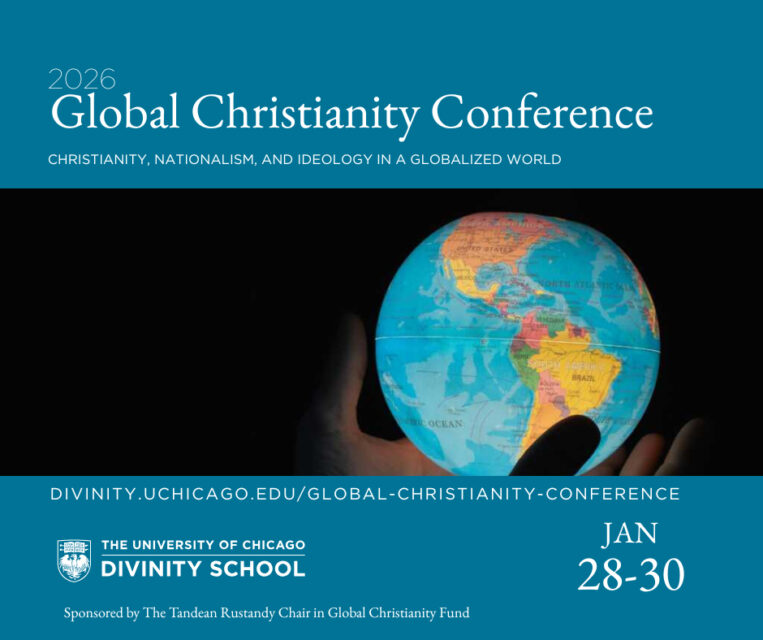
Global Christianity Conference signage. (Courtesy image)