

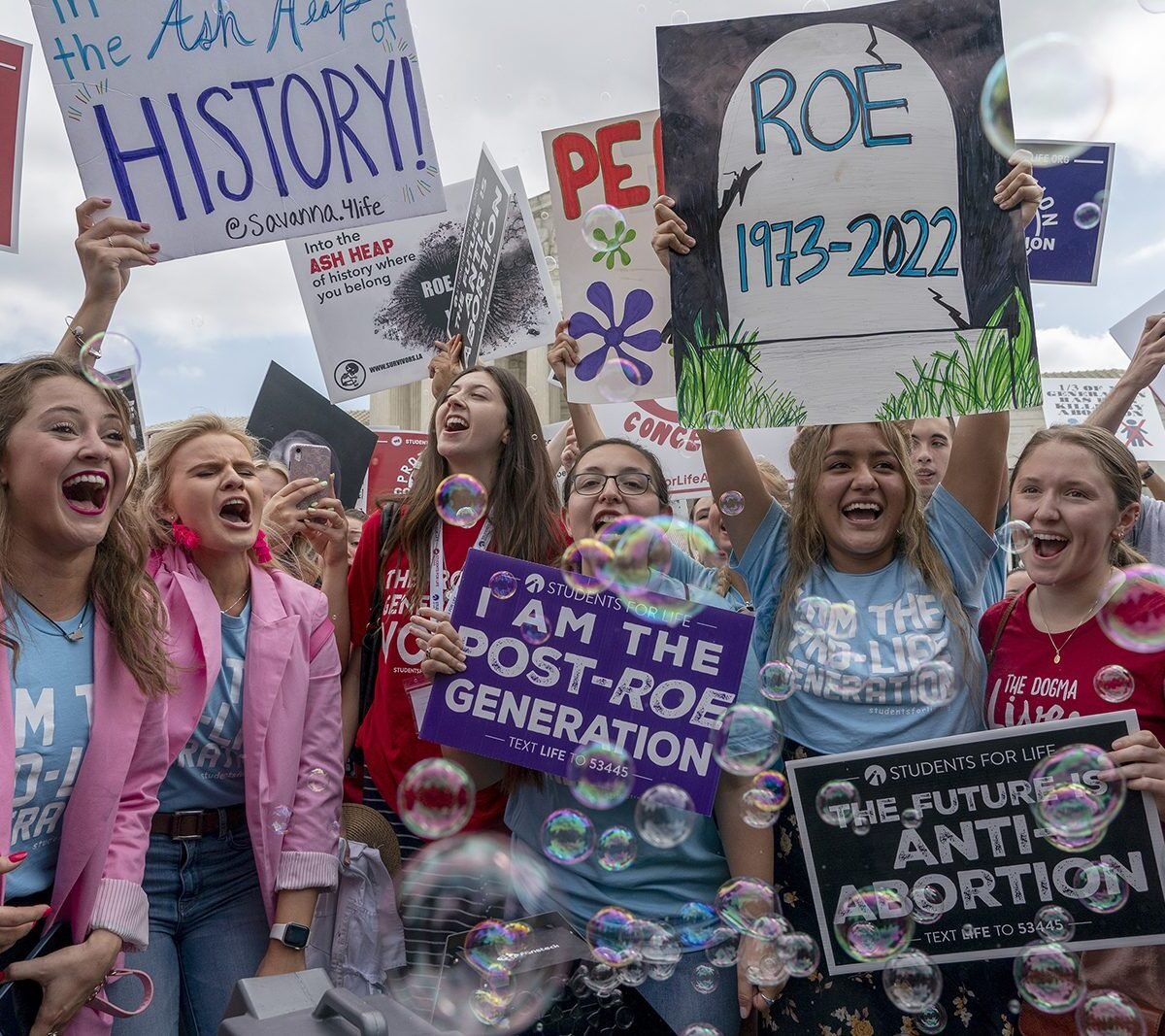
(RNS) — Investigative reporter Amy Littlefield loved Agatha Christie murder mysteries and especially the character Miss Marple, the older lady detective. So, in 2022 when the Supreme Court overturned Roe v. Wade, ending the 50-year-old right to abortion, Littlefield put on her inner Miss Marple to investigate who was responsible for killing the law.
In her book, “Killers of Roe: My Investigation Into the Mysterious Death of Abortion Rights,” Littlefield interviewed some of the leading figures in the anti-abortion movement. She made no bones about her own views. She is a feminist, a fierce believer of the right to an abortion and an atheist. She is also the mother of two children.
She nonetheless scored interviews with people such as Paul Haring, who first approached Catholic bishops with the idea that would become the Hyde Amendment, the 1976 provision that prohibits Medicaid from paying for abortions for poor women. She interviewed Richard Viguerie, the pioneer of political direct mail and the “funding father” of conservative strategy; Randall Terry, the founder of Operation Rescue, which in 1987 began blockading the entrances to abortion clinics; and Mark Lee Dickson, the pastor who led the charge for “sanctuary city for the unborn” ordinances.
Littlefield also interviewed leaders of the abortion rights movement to try to understand how they view their failure to stanch the anti-abortion forces. She paints poignant accounts of two women who died as a result of botched abortions, Rosie Jimenez and Becky Bell.
The book offers a sobering and compassionate critique of society’s failure to protect women — and especially poor women. RNS spoke to Littlefield, who lives in Boston, via Zoom. The interview was edited for length and clarity.
How did you get all these leaders of the conservative anti-abortion movement to agree to talk to you?
I honestly think being upfront about my point of view and my motives was helpful. I think there’s a huge amount of skepticism and even vitriol in the conservative space toward the media right now. As someone who was able to say, “Look, I am left-leaning. I am pro-abortion rights, but I still want to talk to you, because you pulled off this incredibly impressive victory and defeated Roe v. Wade, and frankly, I want to understand it better.” It was appealing to them, to get to tell that story of triumph.

Many of those anti-abortion campaigners had sincere religious motivations. They also identified with unborn fetuses. Explain that.
As a feminist, I’m so used to thinking about the anti-abortion movement as being motivated by misogyny and by a desire to control women, and I don’t think that’s necessarily inaccurate. But when I would ask people what motivated them, they would say some version of “My anti-abortion activism will get me into heaven.” It just felt so simple, so transactional to me. I also found it a little poignant at times the way some of these men seem to identify with the unwanted fetus and to feel unwanted in some way themselves. Randall Terry talked about how, when his mom was pregnant with him, that it was an unintended pregnancy. Mark Lee Dickson, who is an anti-abortion pastor and creator of the “sanctuary city for the unborn” initiative, talked about seeing a connection between abortion and suicide and this idea that everybody should feel wanted. I’m not a psychologist, but it was a pattern I noticed that many of these men seem to have a really difficult time with the idea that a woman could reject a pregnancy.
Was religion driving them more than politics?
It’s all connected. Many of these men believe God communicates with them directly. They believe their interpretation of God’s plan for humanity is the correct one. Paul Haring is following the Catholic Church’s teachings and what he believes the world should look like based on that vision of the world. There are traditional gender roles for men and women, and becoming a mother is the highest possible role a woman could fulfill. It’s not right for a woman to prioritize her career or her hopes or dreams or even her health over the embryo or fetus that she’s carrying. And so, I think it’s all connected to this Christian right view of the world, and very much tied into the role that they see for women in society. Paul Haring didn’t hate all women, but he seemed to reserve his reverence for women who followed the path taken by the Virgin Mary and were willing to sacrifice their own bodies and well-being for the pregnancy they were carrying.
You also have criticism of the left and some of the leaders of the abortion rights movement. What mistakes do you think the left made?
The big mystery I was trying to solve is how it’s possible that a constitutional right that has long been supported by a majority of Americans was eliminated. One was a failure to really build a grassroots movement that focused on state legislatures. Most anti-abortion legislation came out of the states, not the federal government, including the law that was used to ultimately reverse Roe v. Wade at the Supreme Court. The abortion rights movement did not have power in the red and purple states where these bills were being advanced.
Another was the huge focus on keeping abortion legal, which left out the people for whom abortion was not accessible. Groups like NARAL offered a limited vision of abortion rights centered on choice that families should be able to make independent of government intervention. On one level, it worked really effectively to win public support from moderates and conservatives who might not otherwise have supported abortion rights, but it had this unintended effect of making abortion sound like a conservative issue and allowing it to fit into a paradigm of limited government. And so the focus on choice rather than on the much more expansive framework of reproductive justice didn’t resonate with low-income folks for whom it was an economic issue. Many people make choices about an abortion based on what they can afford, and yet we don’t talk about it as an economic issue.
Your book focuses less on the death of Roe as on the annual funding of the Hyde Amendment. Why is that?
I saw the Hyde Amendment as the smoking gun in the death of abortion rights. The story starts almost immediately after Roe v. Wade was decided, when conservatives realized that if they weren’t able to ban abortion for everyone, they could ban abortion for poor women, who were far less popular than the legal right to abortion itself. And I tell the story of how strategic they were about it, how they used this sort of backdoor maneuver and tacked it onto an appropriations bill, and the arguments they made in support of the Hyde Amendment, namely that taxpayers — which is code for white male property owners — shouldn’t have to pay for abortions, and that somehow they were saving babies who might otherwise have been aborted because their parents were poor, and so they had this whole paradigm of like, saving Black babies. I think that foreshadowed the way that the anti-abortion movement would offer itself to conservatives as a civil rights movement for white people that copied the rhetoric and the moral righteousness of the Black-led civil rights movement — but offered a way to dismantle abortion rights and the rights of people of color while claiming that self-righteous banner. That was all contained in this early anti-abortion victory.
You speak with two women in the book who were for abortion rights and yet supported presidents who did their best to deny abortion rights. How do you explain that?
That was really chilling to meet a docent who volunteered her time at a library dedicated to the memory of Ronald Reagan, but didn’t realize Reagan had been anti-abortion. That shocked me, and I think it was emblematic of a lack of awareness of history among many voters, and also a lack of awareness of the abortion issue in general. The (other) woman I talked to outside the polling place in Amarillo, Texas, was voting against the anti-abortion ordinance in one of the most conservative areas of the country, and yet she was voting for Donald Trump, who had appointed the Supreme Court justices who overturned Roe v. Wade. She told me she was OK with Trump, having turned the issue back to the states. She lived in a state that had banned abortion completely, and so that was an example of being drawn in by this rhetoric Trump was using to position himself as a moderate after the Dobbs decision. And I think the lack of understanding and a high degree of confusion around anti-abortion laws — I think that serves politicians like Donald Trump, who rely on that confusion to be able to shape themselves as moderates as they may need to convince different factions of their electorate.
You end the book on a hopeful note. What gives you hope?
My argument is that justice doesn’t come in big, dramatic moments. It comes from people often acting behind the scenes, outside the political spotlight, doing the work of making justice themselves. And I see that work happening when I see city councils passing unprecedented ordinances to expand access to abortion. I see that in the clinicians who are risking their liberty to mail medication abortion into Texas and other states where abortion is banned. I see that in the daily work of abortion funds that are figuring out, in a very unglamorous way, how to get somebody in a rural corner of Alabama the abortion they need. I see it in the work of Black-led reproductive justice organizations who have long been advocating for a much more expansive vision of abortion rights within a wider framework of the right to parent, the right to raise kids safely — and who are doing that work in a moment where those are under direct threat by immigration raids, by increased criminalization of people of color. I see hope in the fact that organizations and activists who have more radical visions of reproductive justice are kind of making their way to the forefront in the wake of this monumental loss. We’re seeing the folks who have a more justice-oriented frame gaining momentum, I think even in this moment of profound loss.