

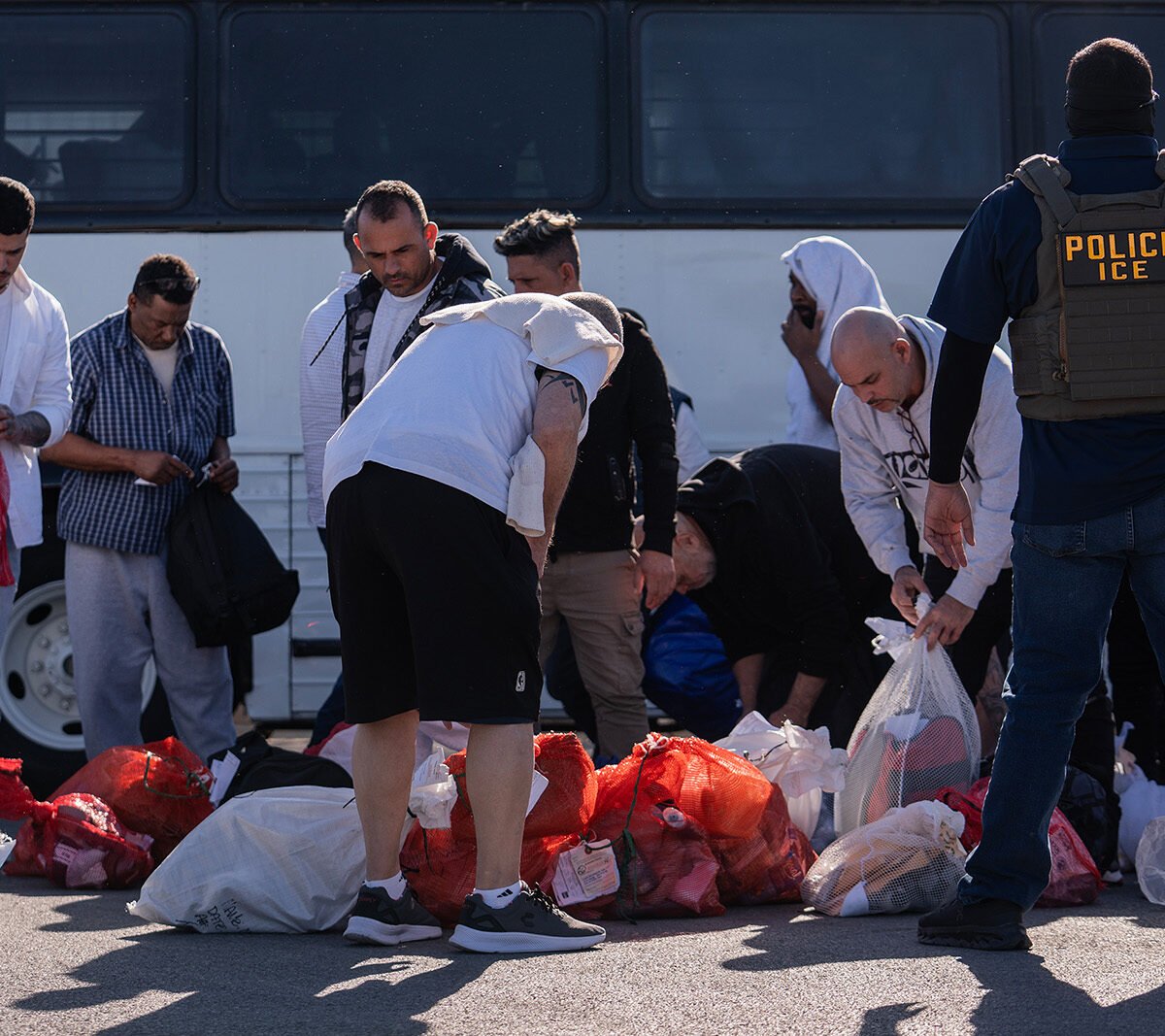
(RNS) — A new report created by a pair of evangelical Christian organizations is raising alarms about the effects of President Donald Trump’s mass deportation effort on families, arguing that more than 1 million people could be “torn apart” from their families if current immigration policies continue at expected rates.
The report, which was released on Monday (May 4), was produced through a partnership between two prominent evangelical Christian organizations: World Relief, which helps resettle refugees, and the National Association of Evangelicals, an umbrella organization that represents a broad swath of evangelicals. Titled “Joined Together, Torn Apart: How U.S. Immigration Policies Are Separating Families,” the report argues Trump’s controversial immigration policies are harming families by separating spouses as well as children from their parents through deportations and detentions.
The authors stress they are “not saying that all deportations are unjust or unwarranted,” but cite Scripture to argue that “Jesus makes abundantly clear that what God has joined together in marriage, human institutions should not separate.”
On a press call with reporters on Monday, NAE President Walter Kim said family is a critical concept for evangelicals like himself.
“Evangelical concerns about immigrants, about widows, orphans — these are public policy concerns,” he said. “But more fundamentally, they’re theological concerns. They’re biblical concerns.”
The report draws its conclusions from the administration’s own goals — namely, plans to deport 1 million people a year and “an indefinite pause on immigrant visas for 75 countries.” Using that rubric, the report argues that 910,000 U.S. citizen children would be separated from one or both of their parents by early 2029, and 272,000 U.S. citizen spouses would be separated from their partner. What’s more, because of the ongoing pause on immigrant visas from some countries, 150,000 spouses and children would also remain separated abroad from their U.S. citizen spouses and children during that time.
Altogether, the report argues, 1.3 million people would be impacted.
“The grief and trauma U.S. citizen spouses and U.S. citizen children are experiencing is unimaginable,” the report reads. “Part of the church’s responsibility is to come alongside families inside and outside of their congregations.”
Myal Greene, head of World Relief, noted many of those detained and deported during the Trump administration’s mass deportation campaigns do not have criminal histories — and some, he said, entered the country legally.
“Family separation is not only happening among those who entered unlawfully,” he said, adding that even families that are reunited can be “permanently scarred.”
Asked about the criticisms in the report, White House spokesperson Abigail Jackson suggested the Trump administration has no plans to abandon its broader mass deportation agenda.
“President Trump was elected as the President of the United States based on the many promises he made to the American people, including his promise to deport criminal illegal aliens,” Jackson said in a statement. “He is keeping his promise to the American people.”
The report builds on a separate study released last year by the NAE along with the U.S. Conference of Catholic Bishops, which argued that 1 in 12 Christians in the U.S. were vulnerable to deportation or live with a family member who could be deported.
The press call also featured two Texas pastors — Pastor Elias Rodriguez, who leads Casa Nueva Voz and founded the group Hope Invasion, and the Rev. Walter Thompson, head of First Presbyterian Church in Midland, Texas. The two detailed how they have worked to care for the children whose parents have been deported or detained, with Rodriguez and Thompson each caring for children in their own homes.
Thompson noted that, although he lives in an “overwhelmingly red conservative Christian community,” he was surprised by how quickly people rushed to assist the two girls he cared for. Many locals offered diapers and other supplies such as DoorDash credits and home-cooked meals.
“Every time I shared the story of these little girls and what we were doing — their separation from mom and dad — the response was that they wanted to help,” Thompson said.
The girls were recently reunited with their family in Venezuela, the pastor said, but he fears the same situation will befall others.
“We are thankful that they’re home, but we remain very concerned about policies and systems that allow for this kind of separation,” he said, referring to the girls.
Despite recent drops in support for Trump’s immigration policies among many religious groups, he continues to enjoy robust backing from evangelicals — particularly white evangelicals. According to a March poll from the Public Religion Research Institute, 69% of white evangelicals expressed favorable views of how Trump is handling immigration — more than any other religious group. White evangelicals were also more likely to voice support for more extreme immigration proposals, with 63% voicing support for detaining immigrants in internment camps, and were the only group to show majority support (51%) for detaining and relocating undocumented immigrants without due process.
But Kim pointed out that there are many multiethnic evangelical churches with immigrants in their pews, and that the realities of the mass deportation policy are starting to be felt by churches he works with.
“What might have been an abstract policy decision that’s taking place in Washington now is actually impacting communities,” he said. “Churches that are multi-ethnic, who are seeing fellow members of youth groups coming in incredibly distraught because of what’s unfolding with parents — that’s happening on the local church level.”
Greene also expressed hope that the report itself could help change hearts and minds and referenced Trump’s dwindling approval numbers.
“As more information like this becomes accessible to people, whether they’re church leaders or just concerned citizens or church members, their opinions are frequently shifting,” he said. “I think that’s why we’ve seen a decline nationally in support for the current administration’s immigration policies.”