
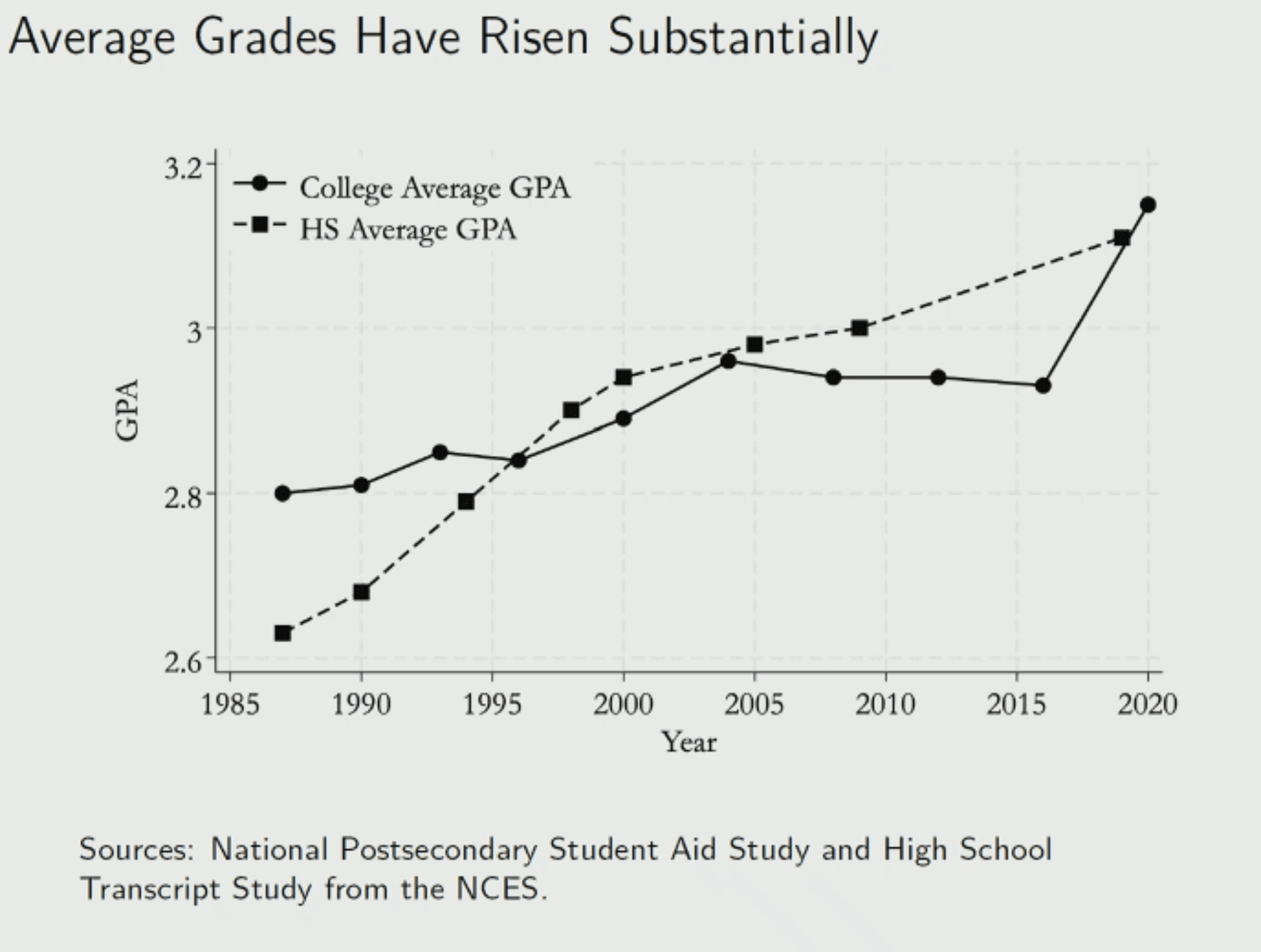
But its findings are striking and build the argument against raising grades.
Students who experienced more lenient grading were less likely to pass subsequent courses, posted lower test scores afterwards, were less likely to graduate from high school and enroll in college, and earned significantly less years later.
The economic cost is not small. Denning estimates that when a teacher doles out grades that are substantially higher (0.2 or more points on a 4-point scale, the difference between a B and almost a B-plus), a student in that class loses about $160,000 in lifetime earnings, measured in present dollars.
That’s the effect of a single teacher, in a single year. If a student encounters several grade-inflating teachers, the losses add up.
Evidence from two very different places
The researchers examined students in two settings: Los Angeles and Maryland.
Los Angeles Unified School District provided data on almost a million high school students from 2004 to 2013, a period when graduation rates hovered just above 50 percent. The student population was more than 70 percent Hispanic, and failing grades were common.
Maryland’s data followed about 250,000 high school students from 2013 to 2023. Graduation rates exceeded 90 percent, and the student population was more racially mixed. Maryland’s data allowed researchers to track college enrollment, employment and earnings, while the Los Angeles data ended with high school.
Despite these differences, the pattern was the same.
Students taught by lenient graders — defined as teachers who gave higher grades than expected based on standardized test scores and prior student performance — did worse later in high school. In Maryland, where there was data through college and into the workplace, these students were also less likely to attend college or be employed, and earned less.
Seeing the same pattern in two very different systems strengthens the case that this is not a fluke of one district or one policy regime.
When leniency helps and when it doesn’t
The study makes a crucial distinction. Teachers who still kept A’s challenging, but only made it easier to pass — turning failures into low passing grades — did help more students graduate from high school, particularly those at risk of dropping out. That short-term benefit is real. For some students, passing Algebra I instead of failing it can keep them on track to graduate and possibly enroll in community college.
But the benefit stops there. Those students do not show long-term gains in college degree completion or earnings. The leniency helps them clear a hurdle, but it does not build the skills they need afterward.
By contrast, general grade inflation (teachers who raise grades across the board, from C’s to B’s to A’s) shows no upside and hurts students’ chances of future success.
Why good intentions backfire
The study cannot directly explain why higher grades lead to worse outcomes. But the mechanism is not difficult to imagine. In a class with a lenient grader, a savvy student may quickly realize she does not need to study hard or complete all the homework. If she earns a B in Algebra I without learning how to factor or solve quadratic equations, the knowledge gaps follow her into geometry and beyond. She may scrape by again. Over time, the deficits compound. Confidence erodes. Learning slows. In college or the workplace, the consequences show up as lower skills and lower pay.
As Denning put it during the presentation, there appears to be a “causal chain” of harm, even if he cannot measure directly how much less students are studying or how behind they’ve fallen.
Don’t rush to blame teachers
Raising grades isn’t always an individual instructor’s decision. A 2025 survey documents the frustrations of many grade-inflating teachers who say that they feel pressure from administrators to comply with “equitable grading” policies that forbid zeros, allow unlimited retakes and eliminate penalties for late work.
Lenient graders are not bad teachers. The study finds they are often better at improving non-cognitive skills. Their students behave better, cooperate more, and are less likely to be suspended. Still, in this study, that’s not translating into better life outcomes, as one would hope.
Stricter graders tend to be better at raising students’ test scores in math, reading and other academic subjects. Despite that correlation, that doesn’t mean all tough graders are good teachers. Some are not.
This is early research. More studies are needed to understand whether there are similar workplace costs from college grade inflation. And there are questions about whether boys react differently than girls to inflated grades.
Teachers struggle to get students to engage in learning, which is full of setbacks, frustration and boring repetition. Maybe low grades won’t inspire students to do this hard work. But this early evidence suggests that inflated grades aren’t doing them any favors.
Contact staff writer Jill Barshay at 212-678-3595, jillbarshay.35 on Signal, or barshay@hechingerreport.org.