
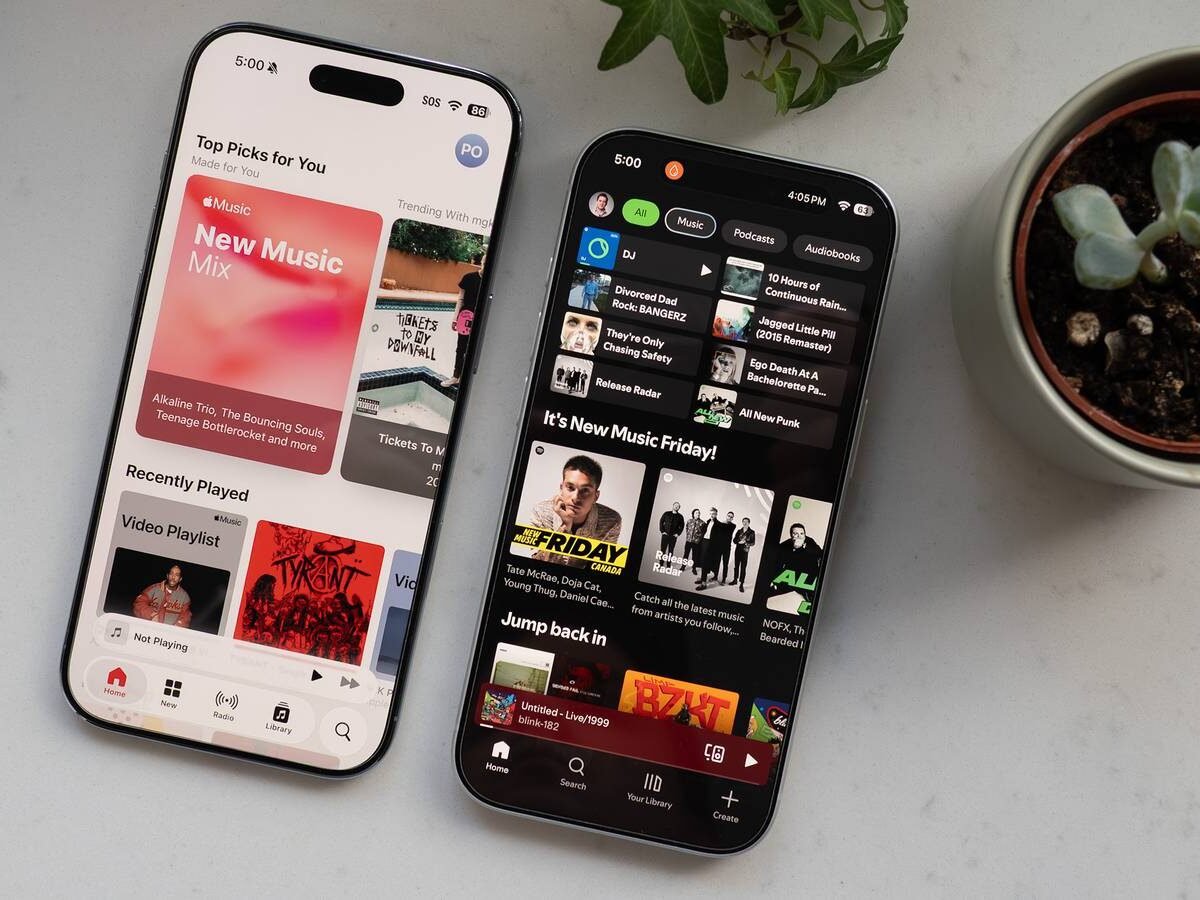
Like a lot of you, I have problems with Spotify as a business. It still doesn’t pay artists well enough; it’s not doing enough to combat AI slop; and until recently, it was hosting ICE recruitment ads in the US. Under sustained pressure, the company does eventually seem to budge on issues, but you’d think it wouldn’t be that hard to get things right from the outset.
I continue to use Spotify for one overarching reason: practicality. I’d love to be able to switch to an alternative like Apple Music, but since I stream music virtually all day — at work, on my EUC, and at the gym — being able to listen how I want matters almost as much as what I’m listening to. Below are just a few of the things that are keeping me hooked, at least for now.
Spotify Connect
No device is an island

There’s a surprising number of Apple devices in my house. My son, wife, and I all have iPhones and iPads, even if none of them are new. We also have a few Macs, Apple TVs, and HomePod minis, plus the Apple Watch I use to track all that gym time.
You’d think that would make me an ideal candidate for Apple Music, but that’s where you’d be wrong. My work machine is a Windows laptop, and most of the time, I’m listening to music on an Amazon Echo Studio paired with an Echo Sub. There’s just no easy way to switch between all of my output devices with Apple Music, since most of the time, Apple forces AirPlay for casting. You do get Google Cast if you’re using the Android app, but that doesn’t help much in my scenario.
Spotify Connect is genuinely multi-platform, so I don’t have to lock myself into an ecosystem to get the full benefits.
Spotify Connect lets you switch output to any device the service is running on. If my Echo Studio is acting up, for instance, I can always fall back to listening on my iPad with a few clicks. I could also push music to my TV’s soundbar, or play it on every Echo in my home simultaneously. Can you tell I’ve reviewed a lot of smart home gear?
The tech does have problems occasionally, most notably the limitation on one stream per account, regardless of where it’s playing. For a while there, my son had a bad habit of hijacking my gym soundtrack during his bathtime. Still — Spotify Connect is genuinely multi-platform, so I don’t have to lock myself into an ecosystem to get the full benefits.
Tailoring playlists to your tastes
That je ne sais quoi

To Apple’s credit, it’s been gradually getting better at personalized playlists. Aside from artist, genre, and new release selections, you get your own station, and even a Discovery Weekly equivalent called the Discovery Station. But if you want a steady dose of variety and new-to-you content, Spotify wins, and the competition isn’t even close.
Perhaps my favorite playlist on Spotify at the moment is the Daylist. This analyzes your hourly habits, and generates an ever-shifting playlist meant to last an entire day. As I write this, for instance, it’s promising me a “dungeon synth martial industrial tuesday morning.” If I tuned in later, the genre mashup would look completely different. I may put on Release Radar, an album, a custom playlist, or a Daily Mix if I’m in the mood for something specific, but the Daylist has me covered the rest of the time.
While the company could be doing a better job at curbing low-effort AI “artists,” it’s at least it’s introducing you and I to humans who could use the exposure.
Spotify is also making some good use of AI in this arena. There’s a DJ mode if you want a radio-like experience, and depending on your country, you may already be able to spawn original playlists based on text prompts and emoji. So while the company could be doing a better job at curbing low-effort AI “artists,” it’s at least it’s introducing you and I to humans who could use the exposure.
Apple Music retains a heavy focus on curated playlists. That could change now that Google Gemini is being integrated into Siri and Apple Intelligence — but I need to see better parallels with Spotify before I consider switching.
A free fallback
No need to panic when money is tight

One of the reasons Apple Music can afford to pay musicians better — apart from belonging to a $3 trillion megacorporation — is that every long-term customer is a paid one. You can potentially listen for a few months free during your trial, but after that, it’s strictly pay-to-play. Many of Spotify’s listeners are only generating ad revenue.
There is a strategic advantage to that, however: capturing customers who otherwise couldn’t afford anything. Contrary to what many tech CEOs think, not everyone has an infinite budget for subscriptions, and one of the first sacrifices anyone is going to make is entertainment.
It means you can’t suddenly be locked out of your music collection because paying the rent and grocery bills briefly took priority.
From a listener’s perspective, there are plenty of reasons to upgrade to Spotify Premium when you can afford it, such as ad-free listening, audiobooks, and offline caching. But knowing Spotify Free exists is reassuring. It means you can’t suddenly be locked out of your music collection because paying the rent and grocery bills briefly took priority. When you’re back on your feet, then you can worry about catching up on Hitchhiker’s Guide to the Galaxy, or getting rid of that O’Reilly ad jingle.
Offline Backup
Something is better than nothing

It’s taken for granted that any streaming service will let you cache material for offline listening, since even in 2026, there are still plenty of times when internet access is interrupted or impractical. When I was living in Texas, for example, saving offline playlists was almost mandatory, since there were surprisingly long stretches of highway with little to no cellular signal.
Offline Backup uses a sorcerous algorithm to serve up tracks without consuming a ton of extra storage.
The difference with Spotify’s Offline Backup is that you don’t need to pick playlists ahead of time. You can if you like, but Offline Backup is always available on your phone or tablet, using some sort of sorcerous algorithm to serve up tracks without consuming a ton of extra storage space. My own backup is two hours long, which would certainly be enough to get me through the worst parts of a drive from Austin to Houston.
It’s not perfect, of course. It gravitates towards recently or heavily-played tracks, and as I mentioned, it’s mobile-only. You’re out of luck if you want to use it on your laptop or desktop — which seems ridiculous given the greater storage most computers have. Still, Apple could stand to implement something similar, acknowledging that not everyone lives in an area completely blanketed by 5G and Wi-Fi. Even if you do, some providers continue to impose data caps, and I’d rather listen to a few old tunes than risk apps like Google Maps being throttled.